

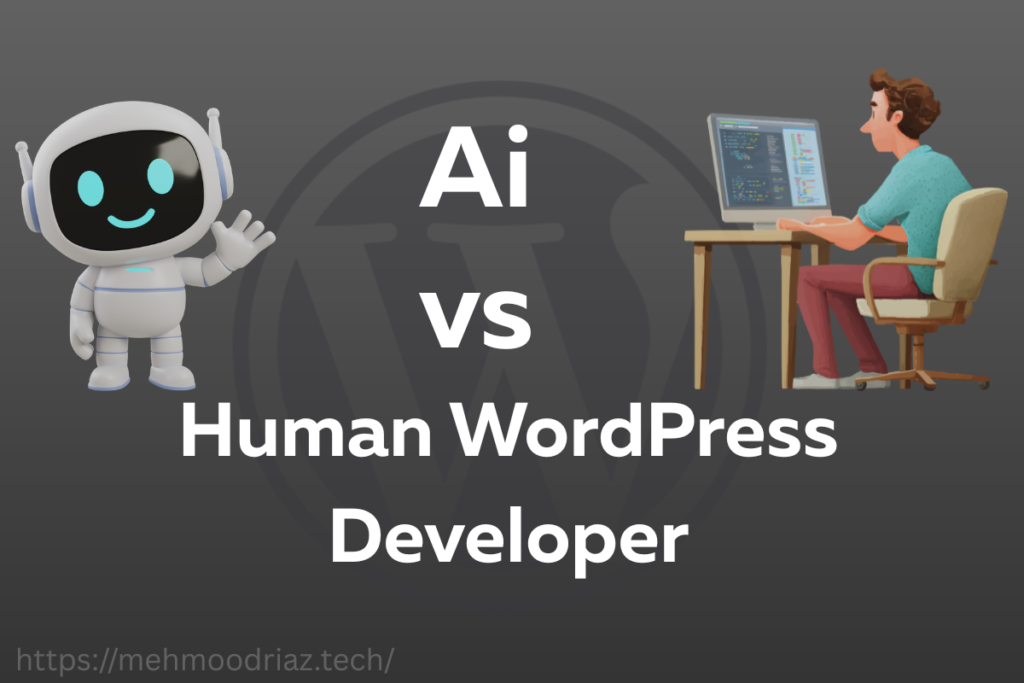
AI vs Human WordPress Developer: Which One Should You Choose in 2026?
In recent years, artificial intelligence has started transforming how websites are built. Tools that once required coding knowledge can now generate complete websites with just a few prompts. As a result, many business owners are asking a simple but important question: Should I build my website using AI or hire a WordPress developer? At first glance, AI website builders seem incredibly attractive. You type a description, choose a style and the system generates pages, images and layouts within minutes. For someone who wants a quick website, it feels like magic. However, when it comes to building a professional website that represents your brand, attracts customers and performs well in search engines, the decision becomes more complicated. In this guide, we will honestly compare AI website builders and human WordPress developers so you can decide which option is truly best for your website. What Is an AI Website Builder? An AI website builder is a tool that uses artificial intelligence to automatically generate a website based on simple instructions. Typically, you provide information such as: Your business type Industry or niche Design preference Required features (blog, store, booking system) The AI system then generates: Website layout Content sections Images and colors Basic SEO settings Within minutes, you have a functional website. Many modern platforms now include AI builders and some can generate landing pages, small business sites and personal portfolios almost instantly. While this speed is impressive, AI-generated websites often come with limitations that many users only discover later. What Is a Human WordPress Developer? A WordPress developer is a professional who builds websites using WordPress, the world’s most popular content management system. Instead of automatically generating everything, a developer: Designs a custom layout for your brand Optimizes the site for performance and SEO Installs and configures the right plugins Ensures security and scalability Customizes features based on your business needs Unlike AI builders, a developer can adjust every part of the website to match your goals. This human expertise is especially valuable for businesses that want their website to generate leads, sales, or long-term growth. AI Website Builder vs Human WordPress Developer Below is a simple comparison to help you understand the differences. Feature AI Website Builder Human WordPress Developer Setup Speed Very fast (minutes) Slower (days or weeks) Customization Limited Highly customizable SEO Optimization Basic SEO only Advanced SEO strategies Design Quality Template-based Fully customized design Scalability Limited Can scale with business Security Depends on the platform Fully configurable Maintenance Automated but limited Professional management Cost Usually cheaper initially Higher upfront cost This comparison shows that AI focuses on speed, while developers focus on quality and long-term growth. Advantages of AI Website Builders AI builders are becoming popular for several reasons. 1. Extremely Fast Setup The biggest advantage is speed. Instead of spending days building pages, you can generate a complete website within minutes. For individuals who need a quick online presence, this can be very useful. 2. Beginner Friendly Most AI website builders require no coding knowledge. Everything is handled automatically, which makes them attractive to beginners. 3. Lower Initial Cost Many AI platforms offer free trials or affordable monthly plans. This can be helpful for small projects or personal websites. 4. Quick Idea Testing AI builders are perfect for testing new ideas. If you want to launch a quick landing page or validate a business concept, they can help you do that quickly. 4. Quick Idea Testing AI builders are perfect for testing new ideas. If you want to launch a quick landing page or validate a business concept, they can help you do that quickly. Limitations of AI Website Builders Despite the convenience, AI builders also have several important limitations. Limited Customization: AI builders typically rely on templates. While they may generate designs automatically, you often have limited control over deeper customization. Basic SEO Capabilities: Most AI-generated websites include only basic SEO settings. Advanced strategies such as structured schema, technical SEO and speed optimization often require manual work. Platform Lock-In: Many AI builders are closed systems. This means your website is tied to their platform and moving your site elsewhere can be difficult. Integration Challenges: As your website grows, you may want advanced features such as CRM integration, custom plugins, or automation tools. AI platforms may not support these easily. Advantages of Hiring a WordPress Developer While AI builders focus on automation, WordPress developers focus on strategy and long-term results. Fully Customized Design: A developer can design your website specifically for your brand instead of relying on templates. This helps your business stand out and creates a more professional impression. Advanced SEO Optimization: A skilled developer understands technical SEO, page speed optimization, schema markup and other factors that help your website rank in search engines. This can make a major difference in attracting organic traffic. Better Performance: Developers can optimize code, compress assets, configure caching and implement content delivery networks to improve site speed and performance. Scalability: Your website may start small, but your business will grow. A developer can build a structure that supports: eCommerce Membership systems Booking tools Marketing integrations This flexibility ensures your website can grow with your business. When Should You Use an AI Website Builder? An AI builder may be the right choice if: You need a simple website quickly Your site is temporary or experimental You are building a personal blog or portfolio Your budget is very limited In these situations, AI can provide a fast and simple solution. When Should You Hire a WordPress Developer? Hiring a developer is usually the better choice if: You are building a business website You want SEO traffic and long-term growth Your site requires custom features You plan to scale your website in the future A developer ensures your website is built with strategy rather than just automation. AI vs Human Developer: The Honest Verdict AI website builders are impressive tools. They can generate websites quickly and make the process easier for beginners. However, they are not a complete replacement for human
10 Tips to Speed Up a WordPress Site in 2026
10 Tips to Speed Up a WordPress Site in 2026 Best way of WordPress speed optimization in 2026. WordPress powers 43.4% of all websites as of July 2026, over 532 million sites worldwide. Despite its popularity, the average WordPress site still loads in 2.5 seconds on desktop and 8.6 seconds on mobile. In 2026, site speed is no longer optional, Google prioritizes fast-loading sites through Core Web Vitals and slow sites lose visitors, conversions and rankings. This guide covers practical WordPress speed optimization tips that work in 2026. Whether you run a blog, eCommerce store, or business website, these strategies will help you deliver a faster, smoother and higher-converting experience. Why Speed Matters for WordPress in 2026 Site speed impacts SEO, user experience and conversion rates. Google’s Core Web Vitals are now essential ranking factors: Largest Contentful Paint (LCP): Target < 2.5 seconds Interaction to Next Paint (INP): Target < 200 ms Cumulative Layout Shift (CLS): Target < 0.1 A slow website frustrates users, increases bounce rates, and reduces engagement. Fast-loading WordPress sites not only retain visitors but also boost search visibility. 1. Pick Fast Hosting Your hosting provider is the foundation of website speed. Shared hosting often becomes a bottleneck under traffic growth. For 2026, managed WordPress and cloud hosting are the top performers. Hosting Provider Type Avg TTFB Key Feature Kinsta Managed 177 ms Google Cloud, auto-scaling WPX Managed 200 ms LiteSpeed, staging environment Cloudways Cloud 190 ms Choice of cloud providers, fast caching SiteGround Managed 210 ms Free CDN integration, reliable support Pro Tip: Choose hosting optimized for WordPress to reduce Time to First Byte (TTFB) and server response time. 2. Use Lightweight Themes Themes with heavy scripts and features slow down load time. Opt for fast, minimalist themes that are optimized for performance. Recommended Themes: GeneratePress: Lightweight & customizable Astra: Optimized for speed & SEO Neve: Fast & mobile-friendly Kadence: Balanced speed and design Pro Tip: Avoid multipurpose themes packed with unnecessary features if speed is your priority. 3. Compress and Serve WebP/AVIF Images Images account for 41% of the total page weight on the web. Optimizing them reduces load time without sacrificing quality. Best Practices: Use WebP or AVIF instead of JPEG/PNG Compress images via plugins: ShortPixel, Smush, Imagify Enable lazy loading: load images only when visible on the screen Resize images to match container dimensions Serve images via a CDN like Cloudflare or BunnyCDN Pro Tip: Check image impact using GTmetrix or PageSpeed Insights before and after optimization. 4. Enable Caching via Plugins Caching creates static page versions to reduce server processing. Top Plugins in 2026: WP Rocket: Paid, all-in-one solution NitroPack: CDN + caching + optimization LiteSpeed Cache: For LiteSpeed servers WP Fastest Cache: Easy setup Advanced Tip: Use Redis or Memcached object caching for WooCommerce or high-traffic sites. 5. Use a CDN for Static Assets A Content Delivery Network (CDN) stores your static files globally. Visitors load files from the nearest server, reducing latency. Recommended CDNs: Cloudflare APO: Free & paid plans QUIC.cloud: Optimized for LiteSpeed BunnyCDN: Affordable & fast Pro Tip: Combine CDN with image optimization for maximum speed improvement. 6. Minify and Combine CSS/JS Files Too many CSS/JS files increase the number of HTTP requests. Reduce page complexity: Combine CSS & JS files Minify code with Autoptimize or Asset CleanUp Remove unused code via WP Rocket Pro Tip: Use GTmetrix Waterfall Analysis to identify unnecessary files. 7. Delay Non-Critical Scripts Scripts like analytics or comment widgets can block rendering. How to Improve: Defer non-essential JS Load third-party scripts asynchronously Use plugins like WP Rocket or Perfmatters Pro Tip: This helps improve Core Web Vitals, especially INP and LCP. 8. Clean Up Your Database A cluttered database slows queries. Regular cleanup is essential. Actions to Take: Remove old plugins, themes, and post revisions Delete expired transients & unused tables Use plugins like WP-Optimize or WP-Sweep Schedule automated cleanups Pro Tip: A lean database reduces server load during peak traffic. 9. Avoid Hosting Videos Locally Videos consume bandwidth. Instead, embed from YouTube, Vimeo, or other platforms to keep your server lean. Pro Tip: Host critical videos via a CDN or streaming service to maintain performance. 10. Keep WordPress Core, Themes, and Plugins Updated WordPress 6.8 introduced 24 performance improvements. Staying updated ensures: Reduced load time & resource usage Security and compatibility with caching plugins Maximum Core Web Vitals performance Pro Tip: Combine updates with backups and staging testing for safety. Benefits of Hiring a Professional WordPress Development Company While DIY optimization works, professionals save time and ensure long-term, data-driven performance improvements. 1. Strategic WordPress speed optimization in 2026 Audit server response time (TTFB) Fix render-blocking assets & theme inefficiencies Implement object caching & CDN setup 2. Expertise With Tools & Tech Stack Mastery of WP Rocket, FlyingPress, Perfmatters, Redis Know when custom code outperforms plugins 3. Better Security and Stability Clean database & malware-free scripts Properly coded, updated themes/plugins 4. Performance-Driven Design Choices Lightweight layouts & mobile-friendly design Avoid oversized sliders, videos, and animations 5. Improved Core Web Vitals for SEO Optimize LCP, INP, CLS Use Lighthouse, Chrome DevTools, and WebPageTest for actionable insights 6. Scalability Modular, maintainable code Structures to handle growing traffic 7. Saves Time Quick auditing & issue resolution Eliminates trial-and-error fixes 8. Ongoing Support Regular updates & database cleanups Performance audits and proactive improvements Final Thoughts WordPress speed optimization in 2026 are critical for SEO, user experience, and conversions. By implementing these 10 speed optimization tips, or hiring a professional development company, you can achieve: Lightning-fast load times (<2s desktop, <3s mobile) Better Core Web Vitals scores Lower bounce rates and higher conversions Improved search engine visibility Start optimizing today, and turn your WordPress site into a high-performing, user-friendly platform ready for the demands of 2026.
Why WordPress Is the Best Website Platform for Small Business in 2026
Introduction Choosing the best website platform for a small business in 2026 is no longer just about launching a website. It’s about building a digital asset that generates leads, ranks on Google, supports growth, and adapts as your business evolves. With so many options available, from SaaS builders to AI-generated websites, business owners are understandably confused. However, when long-term control, scalability, SEO performance and flexibility matter, WordPress continues to outperform alternatives. Let’s break down exactly why WordPress remains the best website platform for small business growth in 2026 and what you risk by choosing the wrong platform. Full Ownership and Control (Why This Matters More in 2026) Many modern website builders operate on a rental model. You pay monthly, but the system controls: Code access Feature limitations Pricing tiers Migration difficulty With WordPress, you fully own: Your domain Your hosting Your content Your data Benefit: You can scale, redesign, migrate, or integrate tools anytime. Risk If You Don’t: You may outgrow the platform and face expensive rebuild costs later. For a growing small business, ownership is strategic security. Built for Growth-Not Just Launch Day Most small businesses start simple: 5-10 pages Basic service details Contact form But within 12-24 months, growth demands change: Location pages Blog content Lead magnets CRM integration Booking systems E-commerce WordPress supports all of this without rebuilding from scratch. Why This Makes It the Best Website Platform for Small Business: It grows with you instead of limiting you. Other platforms may work early on, but often become restrictive when customization or automation becomes necessary. Superior SEO Control in 2026 Search engine optimization is still one of the strongest long-term marketing strategies. WordPress provides complete control over: URL structure Meta titles & descriptions Schema markup Image optimization Internal linking Content structure With tools like Yoast SEO, businesses can fine-tune every page. Benefit: Higher ranking potential for competitive keywords. If Ignored: Limited SEO control means limited organic growth, forcing you to rely more on paid ads. For businesses targeting local or national traffic, this alone makes WordPress the best website platform for small business visibility. Customization Without Platform Limits WordPress has thousands of themes and plugins, but more importantly, it allows custom development. You can build: Service-based websites Membership portals Booking systems Multi-location websites Online stores Lead generation funnels You are not restricted by a platform’s feature roadmap. Website Speed and Performance There is a myth that WordPress is slow. In reality, slow websites are built poorly. When properly configured with: Quality hosting Image optimization Caching Clean theme structure WordPress websites can load extremely fast. Why Speed Matters: Higher conversions Lower bounce rate Better Google rankings A fast site directly increases revenue potential. Cost Efficiency Over Time Some platforms appear cheaper initially. But over time, costs add up: Monthly subscriptions App fees Transaction charges Upgrade requirements WordPress core is free. You pay primarily for: Domain and Hosting Optional premium tools Long-Term Advantage: More control over the budget and scalability. This makes it financially sustainable as the best website platform for small business growth. Content Marketing Advantage In 2026, buyers research before contacting businesses. They search: Costs Processes Comparisons FAQs WordPress was built for publishing content. You can easily: Add blog posts Create FAQ sections Build resource libraries Optimize long-form guides This content builds authority and organic traffic over time. Security and Stability Security concerns often arise with WordPress, but issues usually come from: Outdated plugins Weak hosting No updates When maintained correctly: Regular updates Security plugins Proper backups WordPress is extremely secure. Real Risk: Neglect, not the platform itself. E-Commerce Flexibility For businesses selling products or services, WordPress integrates seamlessly with WooCommerce. This allows: Custom checkout flows Subscription systems Booking payments Digital downloads Hybrid service + store models Unlike rigid e-commerce-only platforms, WordPress combines marketing and sales in one ecosystem. Future-Proof Stability WordPress is open-source and community-driven. It is not tied to one company’s pricing strategy. This ensures: Longevity Continuous updates Global developer ecosystem Long-term reliability For small businesses building a serious digital presence, stability matters. Final Verdict When evaluating scalability, SEO control, customization freedom, ownership and long-term cost efficiency, WordPress clearly remains the best website platform for small businesses in 2026. It is not about trends. It is about control, growth, and sustainability. If your goal is to generate leads, rank on Google, and build a digital asset, WordPress remains the smartest foundation.